
Last Updated: July 2026 | Reading time: 11 min
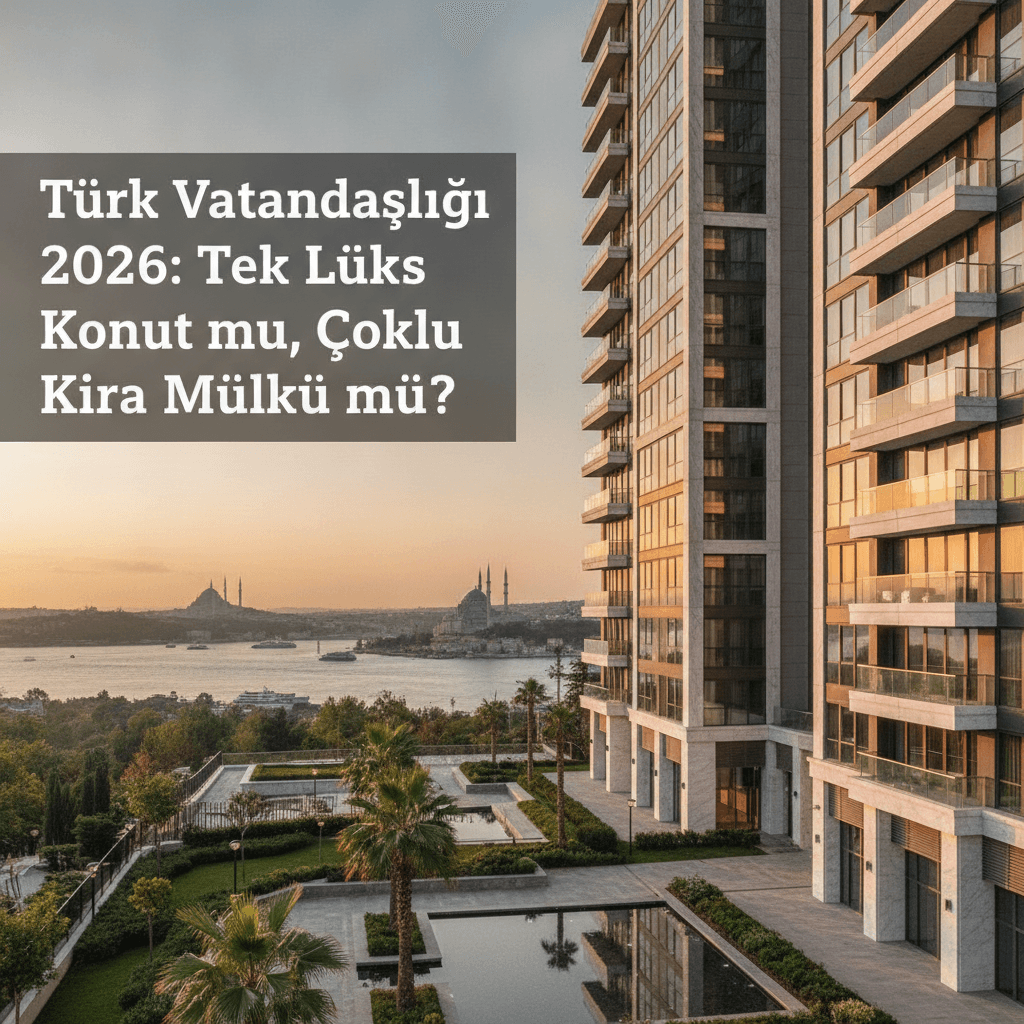
For an investor pursuing the Turkish Citizenship by Investment (TCBI) program, the initial question is often "Which property should I buy?" But as of 2026, with the $400,000 USD threshold holding firm, the more strategic question is how to allocate that budget. Having advised hundreds of international investors in Istanbul, particularly around the prestigious Bağdat Avenue, I can confidently say the answer depends entirely on your personal and financial goals. On one hand, you have the lifestyle and prestige offered by a single, luxurious residence with a Bosphorus view. On the other, you have a portfolio of multiple properties in up-and-coming districts, generating a steady stream of rental income. These two paths lead to vastly different outcomes.
This guide moves beyond a simple property comparison to offer a deep dive into the two primary Turkish citizenship investment strategies. We will analyze not just the present-day value of your investment, but what opportunities it will unlock after the mandatory three-year holding period, how it will impact your tax liabilities, and the managerial complexities each path entails. Our goal is to empower you to make the most informed and profitable decision based on 2026 market conditions.
The Foundation: Understanding the $400,000 Investment Rule
Before diving into strategies, it's essential to grasp the program's core requirement. Under the Turkish Citizenship Law, foreign investors are eligible to apply for citizenship by purchasing real estate valued at a minimum of $400,000 USD. This amount can be for a single property or the total value of multiple properties. This flexibility is precisely what allows for different investment strategies.
Key Points to Remember
- Valuation is Crucial: The value of the property (or properties) must be confirmed by an official appraisal report from a Capital Markets Board (SPK) licensed expert. The value in this report must align with the sales price on the title deed (Tapu).
- Payment Protocol: The transaction must be conducted via a bank transfer. You must obtain a Foreign Exchange Purchase Certificate (Döviz Alım Belgesi - DAB) from the bank, proving the foreign currency was sold to the Central Bank of Turkey.
- The 3-Year Holding Period: An annotation (şerh) is placed on the title deed, restricting the sale of the property for three years. After this period, you are free to sell the property without affecting your citizenship status.
Strategy 1: The Single, Prestigious Luxury Residence
This strategy involves allocating the entire investment budget to one high-value property. Typically, these properties are located in Istanbul's most sought-after districts, such as the Bosphorus shoreline, Bağdat Avenue, Nişantaşı, or tranquil villa communities like Zekeriyaköy. This is more than an investment; it's a lifestyle choice.
Advantages of a Single Luxury Home
- Superior Lifestyle and Prestige: If you plan to live in Turkey, a single luxury home offers unparalleled comfort and social standing for you and your family. Living in a prime neighborhood directly enhances your quality of life and social network.
- Low Management Overhead: One property means one (or no) tenant, one set of utility bills, and one community fee. You avoid the hassle of managing multiple tenants, maintenance requests, and payments across different locations.
- Strong Potential for Capital Appreciation: Historically, properties in Istanbul's prime (A+) locations have proven more resilient to economic downturns and have delivered the highest long-term capital gains. The appreciation of a single apartment on Bağdat Avenue could potentially outperform the combined appreciation of several smaller units in developing areas.
- Easier Liquidity and Financing: When you decide to sell, a single, desirable property often has a more straightforward sales process, even with a niche audience. It's also a more attractive asset for banks if you seek financing in the future.
Disadvantages and Risks
- Concentrated Risk: Your entire investment is tied to a single asset. Any localized issue—a zoning problem, a disruptive urban renewal project nearby, or a decline in the neighborhood's appeal—can negatively impact your whole portfolio.
- Lower Rental Yield: As a percentage of the property's value, the rental return on luxury homes is typically lower. For example, a $500,000 property might yield 2-3% annually, whereas the same budget could acquire a portfolio of smaller units yielding a combined 5-6%.
🏠 Let's Define Your Perfect Investment Strategy
Discover prime luxury residences or high-yield rental portfolios tailored to your goals with our expert team at Century21 Perfect, Bağdat Avenue.
📞 +90 552 688 0195 | 📧 ashkan.ahani@century21.com.tr
Strategy 2: The Multiple Rental-Focused Property Portfolio
With this approach, the investor diversifies the $400,000+ budget across two, three, or more smaller properties. These are often located in developing areas of the city with strong transportation links and growth potential. The primary goal here is maximizing rental income and diversifying risk, rather than personal lifestyle.
Advantages of a Multi-Property Portfolio
- Risk Diversification: This is the most significant benefit. If one unit is vacant, you still collect rent from the others. Properties in different locations mitigate localized risks. A slowdown in one district may be offset by growth in another.
- Higher and Consistent Cash Flow: This is the core purpose of the strategy. You generally achieve a higher overall rental yield relative to the total investment. This steady cash flow can cover your living expenses in Turkey or be reinvested.
- Flexible Liquidity: After the three-year holding period, you can sell one or two properties to free up cash without liquidating your entire investment. This provides immense financial flexibility.
- Tapping into Growth Areas: This strategy allows you to invest in areas poised for significant appreciation due to new metro lines, universities, or major infrastructure projects, capturing value before the market peaks.
Disadvantages and Challenges
- High Management Burden: Multiple properties mean multiple tenants, maintenance issues, and administrative tasks. If you don't reside in Turkey, hiring a professional property management company is essential, which adds to your operational costs.
- Increased Transaction Costs: You will pay separate title deed fees, notary expenses, and appraisal fees for each property, which can increase the total upfront cost compared to a single transaction.
- Uncertainty in Appreciation: Capital gains in developing areas are not as guaranteed as in prime locations. The success of your investment is tied to the quality of the project, the effectiveness of the building management, and the socio-economic trajectory of the area.
Financial Comparison: A 2026 Istanbul Market Scenario
Let's compare the two strategies with a hypothetical budget of $500,000 USD (to cover the threshold and associated costs).
| Criteria | Strategy 1: Single Luxury Home | Strategy 2: Multi-Property Portfolio |
|---|---|---|
| Example Investment | 3-Bedroom Apt on Bağdat Avenue | Two 2-BR apts in Kağıthane, one 1-BR apt in Beylikdüzü |
| Total Cost | ~$500,000 USD | ~$480,000 USD (Total) |
| Est. Annual Gross Rental Yield | $15,000 USD (3%) | $26,400 USD (5.5%) |
| Capital Appreciation (3-Year) | High (Driven by prime location) | Medium-High (Tied to infrastructure) |
| Management Effort | Low | High (Professional help recommended) |
| Risk Profile | Concentrated Single-Asset Risk | Diversified Portfolio Risk |
| Liquidity (After 3 years) | High (Single transaction) | Flexible (Can sell units individually) |
Legal and Tax Considerations
Your chosen strategy will also affect your tax obligations. While foreign investors benefit from advantages like a VAT exemption on their first purchase, differences arise with rental income and capital gains.
- Rental Income Tax: With a multi-property strategy, your higher gross rental income will likely result in a higher tax bill. In Turkey, rental income is taxed at progressive rates after certain exemptions are applied.
- Property Tax and Dues: Owning multiple properties means paying annual property tax to multiple municipalities and monthly maintenance fees to multiple building managements. These fixed costs must be factored into your net return calculations.
- Capital Gains Tax: If you sell your property within five years of purchase and make a profit, you may be liable for Capital Gains Tax. If you plan to sell immediately after the three-year holding period, this tax is a significant consideration. The potentially larger capital gain from a single luxury property could result in a higher tax payment.
Frequently Asked Questions (FAQ)
Can I combine the two strategies?
Yes, it is theoretically possible. For instance, you could use a portion of your $400,000+ budget to buy a modest home to live in and use the remainder to buy a smaller apartment for rental income. However, this may dilute the main advantages of each focused strategy and increase management complexity.
Which areas are best for each strategy?
For the single luxury home strategy, prime districts like Beşiktaş (Bebek, Etiler), Sarıyer (Yeniköy, Zekeriyaköy), Kadıköy (Bağdat Avenue, Fenerbahçe), and Üsküdar (Bosphorus line) are top choices. For a multi-property portfolio, developing areas with new transport links and a high concentration of new projects like Kağıthane, Başakşehir, Beylikdüzü, Kartal, and Pendik offer higher rental yield potential.
How can I reduce the management burden?
For non-resident investors, especially those choosing the multi-property strategy, professional property management companies are a necessity. They handle everything from finding tenants and collecting rent to maintenance, legal issues, and tax filings. This service typically costs between 8-12% of the monthly rent.
Is the title deed value or the appraisal value more important for the application?
Both are important, but the decisive figure is the value stated in the SPK-licensed appraisal report. The sales price declared on the title deed cannot be lower than the appraised value. Your citizenship application hinges on proving the appraised value meets or exceeds the $400,000 threshold.
If I sell the properties after three years, will my citizenship be revoked?
No. Once the three-year no-sale annotation on your title deed expires, you can sell your property without any impact on your citizenship, which is granted for life. The holding period is simply to ensure the program is based on genuine investment in the Turkish economy.
Is the capital appreciation of a single luxury home truly more guaranteed?
Historical data shows that Istanbul's prime locations offer more stable and significant long-term appreciation. However, it's not a guarantee. A well-chosen investment in a developing area with a major new infrastructure project can sometimes yield a higher percentage return than a property in an established prime area. That's why professional guidance is crucial.
How do currency fluctuations affect my investment?
While the investment threshold is set in USD, the actual transactions are conducted in Turkish Lira (TRY). The exchange rate on the day of your payment is what matters. Similarly, when you sell after three years, you will likely sell in TRY and convert it back to your home currency at the prevailing rate. This exposes you to currency risk. However, over the long term, real estate prices in Turkey tend to adjust to track major currency movements.
Conclusion: Defining the Right Strategy for You
As you can see, there is no single "best" Turkish citizenship investment strategy. The optimal choice is deeply personal and depends entirely on your priorities, risk tolerance, and long-term objectives.
You should ask yourself the following questions:
- What is my primary goal? Is it to establish a high-quality life in Turkey, or is it to generate passive income and grow my capital?
- What is my risk appetite? Am I comfortable with concentrating my investment in a single asset, or do I prefer the safety of a diversified portfolio, even if it means more management?
- Cash Flow or Capital Gains? Is a steady monthly income more important to me, or am I focused on the large lump-sum profit I could make from a sale in 3-5 years?
- How much time and energy can I commit? Am I willing to be actively involved in property management, or do I prefer a more passive, "buy-and-hold" investment?
Your honest answers to these questions will guide you to the right path. This is one of the most significant financial decisions you will make. Navigating the process with an experienced consultant will protect you from potential pitfalls and financial loss.
🏠 Professional Guidance on Your Investment Journey
Let's build the perfect Turkish citizenship investment strategy for your goals. Contact us to find the right properties and let our expert team at Century21 Perfect, Bağdat Avenue, manage the entire process for you.
📞 +90 552 688 0195 | 📧 ashkan.ahani@century21.com.tr
- The $400,000 investment for Turkish citizenship can be made with a single property or multiple properties.
- The single luxury home strategy offers prestige, a high quality of life, and lower management effort.
- The multi-property strategy diversifies risk, provides higher rental income, and offers flexible liquidity.
- The two strategies differ significantly in their financial, tax, and management implications.
- The key questions to ask yourself to determine the right strategy for your personal goals.
Aşkan Behbud — Century 21 Perfect, 15+ years of real estate experience, Bağdat Avenue