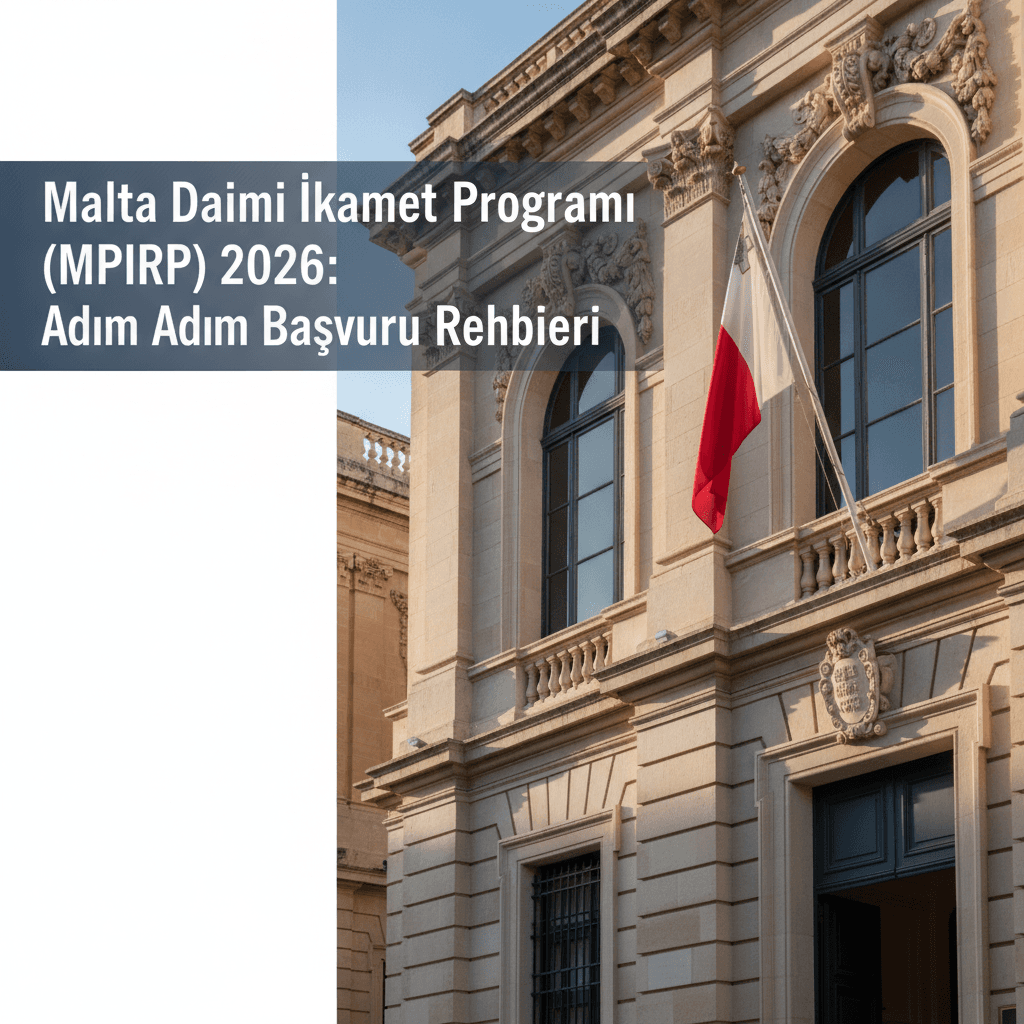
What is the Malta Permanent Residence Programme (MPRP) and Why Is It So Popular?
A stable life within the European Union, quality education for your children, and the freedom to travel visa-free across the entire Schengen Area... These are the goals that feature in the dreams of many global investors and their families. As of 2026, the Malta Permanent Residence Programme (MPRP) stands out as one of the most reliable and attractive pathways to achieving these ambitions. This programme offers non-EU nationals and their families indefinite residency in Malta in exchange for fulfilling specific investment requirements.
What primarily distinguishes the MPRP from other options is its focus on permanent residency rather than direct citizenship. This makes the application process faster and more predictable. Following the closure or restriction of real estate routes in Golden Visa programmes of countries like Portugal and Spain, the MPRP has emerged as a strategic alternative for investors seeking a safe haven in Europe. In this comprehensive guide, we will break down the Malta MPRP application step by step using current 2026 data, detailing costs, legal requirements, and crucial points to consider.
Legal Framework & Eligibility Criteria for the MPRP in 2026
Like any investment immigration programme, the MPRP is built on a solid legal foundation. The programme is regulated by Subsidiary Legislation 217.22 of Malta's Immigration Act. The official body responsible for managing the programme and vetting applications is the Residency Malta Agency. This agency enforces one of the world's most stringent four-tier due diligence processes to ensure the integrity of applicants and the legitimacy of their source of funds.
Who is Eligible to Apply?
To qualify for the programme, the main applicant must meet several key criteria:
- Non-EU Nationality: The applicant must not be a citizen of the EU, EEA, or Switzerland.
- Clean Criminal Record: The main applicant and all dependents over the age of 14 must have a clean criminal record and must not be on any international sanctions lists.
- Good Health: The applicant and their dependents must not suffer from any contagious diseases that could pose a threat to public health.
- Financial Standing: This is one of the most critical requirements. The main applicant must prove they hold capital assets of at least €500,000. Of this amount, a minimum of €150,000 must be in the form of liquid financial assets such as stocks, bonds, or cash deposits.
Which Family Members Can Be Included?
The MPRP is known for its inclusive definition of family. The main applicant can include the following family members in their application:
- The spouse or partner in a long-term relationship.
- Unmarried, financially dependent children of any age.
- Financially dependent parents and grandparents of the main applicant or their spouse.
MPRP Investment Options and Costs for 2026
The Malta Permanent Residence Programme offers applicants two primary investment pathways: leasing a property or purchasing a property. The required government contribution and overall costs vary depending on the chosen route. It is mandatory to maintain the qualifying investment for a minimum of five years.
The table below provides a clear comparison of the cost breakdown for the two investment options.
| Cost Item | Option 1: Property Lease | Option 2: Property Purchase |
|---|---|---|
| Government Contribution | €98,000 | €68,000 |
| Minimum Annual Rent | €12,000 (Malta) / €10,000 (Gozo/South Malta) | Not Applicable |
| Minimum Purchase Value | Not Applicable | €350,000 (Malta) / €300,000 (Gozo/South Malta) |
| Mandatory NGO Donation | €2,000 | €2,000 |
| Administrative Fee | €40,000 (Included in contribution, €10,000 paid on application) | |
🏠 Get Your Custom MPRP Cost Analysis
Let us help you build the most effective cost plan based on your family structure and investment goals. Our team at Century21 Perfect is ready to offer a complimentary initial consultation.
📞 +90 552 688 0195 | 📧 ashkan.ahani@century21.com.tr
The Malta MPRP Application Step by Step (2026 Process)
The Malta MPRP application process is transparent and follows a clear set of steps. It is mandatory to work with a licensed agent throughout the entire process. The journey, which takes an average of 4-6 months, is as follows:
- Engage a Licensed Agent: The first and most crucial step is to sign an agreement with an agent officially accredited by the Residency Malta Agency. The agent will manage the entire process on your behalf, review your documents, and liaise with the government.
- Document Collection and File Preparation: Your agent will request all necessary documents from you and your family (passports, police records, financial statements, etc.). All documents must be officially translated into English and apostilled or legalized.
- Application Submission & Initial Fee Payment: The compiled application file is submitted to the Residency Malta Agency along with a non-refundable administrative fee of €10,000. This is the first installment of the total €40,000 administrative fee.
- Due Diligence Process: The Agency conducts a thorough review of your application and supporting documents. At this stage, the legitimacy of the applicant and their source of funds is meticulously vetted. This is the longest part of the process, typically taking 3-4 months.
- Receive Letter of Approval in Principle: Once the due diligence process is successfully completed, the agency will issue a 'Letter of Approval in Principle'. This letter confirms that your application has been accepted and you can proceed with the investment phase.
- Fulfillment of Investments: Within 2 months of receiving the approval letter, you must fulfill all remaining financial obligations:
- Payment of the remaining balance of the government contribution.
- Purchase or lease of your chosen qualifying property.
- Payment of the €2,000 NGO donation.
- Submission of a health insurance policy covering Malta.
- Biometrics Appointment: After the investments are completed and proof is submitted to the agency, you and your family members will be invited to Malta to provide biometric data (fingerprints and photos).
- Issuance of Residence Cards: Approximately 2-4 weeks after the biometrics are captured, your permanent residence cards will be issued and delivered to your agent. You and your family are now official permanent residents of Malta.
Required Documents Checklist for a Complete Application
Preparing a complete and accurate application file is critical for a smooth process. While your agent will provide a detailed checklist, the core documents generally required are:
- Identity and Civil Status Documents: Copies of valid passports for all applicants, ID cards, birth certificates, and marriage certificate (if applicable).
- Police Clearance Certificates: For the applicant and dependents over 14, from their country of citizenship and any country where they have resided for more than 6 months in the last 10 years.
- Financial Documents: Evidence of the €500,000 in assets (bank statements, property deeds, stock portfolios, etc.) and documents proving the source of these funds (salary slips, company financials, inheritance documents, etc.).
- Health Insurance: A comprehensive health insurance policy covering all family members for treatment in Malta and across the EU, with a minimum coverage of €30,000.
- Proof of Dependency: Documents proving that children, parents, or grandparents are financially dependent on the main applicant (e.g., school enrollment letters, bank transfer records).
- Application Forms: All official application forms provided by the Residency Malta Agency, fully completed and signed.
Common Pitfalls and How to Avoid Them
Investors often encounter a few common issues during the application process. Based on our experience, we strongly advise avoiding these pitfalls:
- Insufficient Proof of Source of Funds: Malta is extremely strict about the source of funds. It is not enough to show you have the money; you must provide a clear, documented trail of how that wealth was accumulated (business activities, employment, inheritance, etc.).
- Making the Property Investment Before Approval: To mitigate the risk of your application being rejected, avoid completing a major property purchase before you receive the Letter of Approval in Principle. The safest approach is to sign a preliminary agreement that is conditional upon receiving approval.
- Missing Document Validity Periods: Certain documents, such as police records, have a limited validity period. It's crucial to time the submission of your file to ensure all documents are still valid.
- Working with Unlicensed Advisors: Only agents officially licensed by the Residency Malta Agency are authorized to submit applications. Engaging with unauthorized individuals puts your time and money at severe risk.
Frequently Asked Questions (FAQ)
Can I work in Malta with a permanent residence permit?
The MPRP permit does not automatically grant the right to work. If you wish to be employed in Malta, you must apply for a separate work permit. However, you are free to register and operate your own company in Malta.
How long is the residence permit valid for?
Your permanent residence status is valid for life. However, for security purposes, the physical residence card containing your biometric data must be renewed every five years. This is a simple administrative procedure.
Do I have to live in Malta?
No, one of the biggest advantages of the MPRP is the absence of any minimum stay requirement. You do not need to spend any specific amount of time in the country to maintain your residence status.
Can my children study in Malta?
Yes, children of residence permit holders can enroll in Malta's state schools or private international schools. They are also eligible to attend the University of Malta and other higher education institutions.
What are the tax implications of Maltese residency?
Malta offers permanent residents a favorable 'resident but not domiciled' tax status. This means you are not taxed on foreign-sourced income that is not remitted to Malta. Only income generated in Malta and foreign income brought into the country are subject to taxation.
Can I sell my property after the 5-year period?
Yes, you are free to sell your property after the mandatory 5-year holding period. However, to maintain your permanent residence status, you must continue to hold a qualifying residential address in Malta (either by purchasing another property or by leasing).
Is the MPRP a pathway to Maltese citizenship?
The MPRP is not a direct citizenship-by-investment program. However, after residing physically in Malta for a number of years (typically more than five), you may become eligible to apply for citizenship through the standard naturalization process. This is a separate and much longer procedure.
Conclusion: Why Malta Could Be the Right Choice for You in 2026
In 2026, the Malta Permanent Residence Programme offers a balanced and attainable option for investors seeking a safe, stable, and prestigious life in Europe. Its transparent application process, broad family inclusion, and lack of a residency requirement make it highly attractive to global investors. At a time when other European countries are tightening similar programmes, the opportunity presented by Malta becomes even more valuable.
However, it is crucial to remember that this process is more than just a financial transaction. A successful application requires careful planning, precise documentation, and professional guidance. An experienced advisor by your side at every step will help eliminate potential obstacles and ensure you reach your goal smoothly.
🏠 Take the First Step Towards Your Future in Europe
Contact our Century21 Perfect office to learn more about the Malta MPRP and to create a personalized roadmap for your situation.
📞 +90 552 688 0195 | Contact Us Today →
- Understanding the Malta Permanent Residence Programme (MPRP) and its legal basis.
- Current eligibility requirements for 2026 and who can be included in an application.
- A detailed cost analysis for both the property lease and purchase options.
- The complete 8-step application process and its estimated timeline.
- Common mistakes to avoid during the application process.
- The rights, obligations, and tax advantages for MPRP holders.