Last Updated: July 2026 | Reading time: 12 min
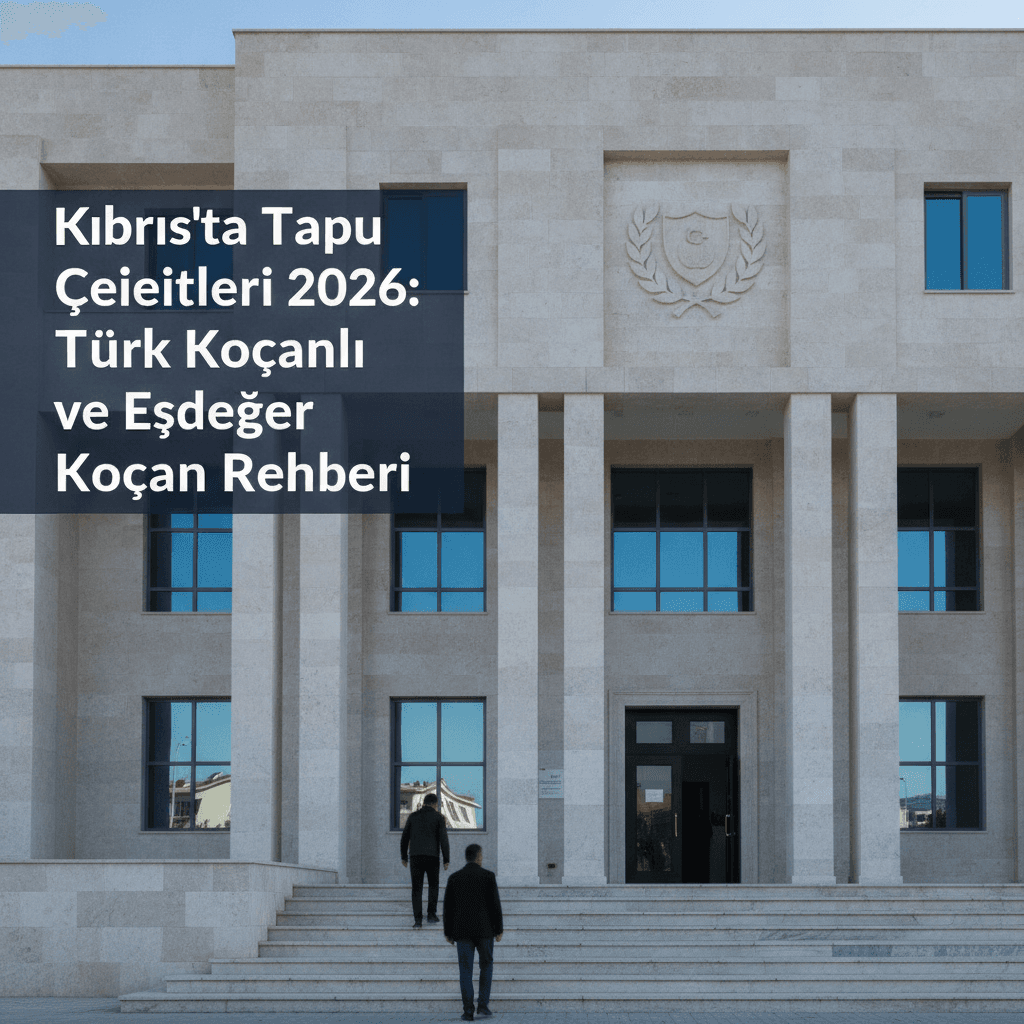
As Golden Visa programs in Spain and Portugal closed their doors and thresholds in Greece soared through 2024 and 2025, the real estate market in North Cyprus has emerged as a global hotspot for savvy investors. Yet, beneath the surface of these glittering opportunities lies a critical foundation every investor must understand: the title deed system, locally known as 'koçan'. Choosing the wrong type of deed can jeopardize a lifetime of savings, while the right choice can unlock generational wealth. This guide is designed to demystify the types of title deeds in North Cyprus as of 2026, focusing on the crucial differences between the coveted Cyprus Turkish title deed and the widely available Equivalent Title Deed.
Don't let terms like 'Türk Koçanlı', 'Eşdeğer Koçan', and 'Tahsis Koçan' confuse your investment journey. In this comprehensive article, we will break down the legal basis, investment potential, risks, and ideal investor profile for each deed type. Our goal is not just to inform you, but to equip you with the necessary tools to make a confident and profitable decision.
By Ashkan Behbud — Century 21 Perfect, 15+ years of real estate expertise, Baghdad Avenue
What is a 'Koçan' (Title Deed) in North Cyprus? The Basics
In the Turkish Republic of Northern Cyprus (TRNC), the official document proving ownership of a property is called a 'koçan'. It is the equivalent of a 'title deed' in English. However, the unique history of Cyprus has led to three main types of koçan, differentiated by the property's ownership status before and after 1974. Understanding these distinctions is vital for the security and future value of your investment. No matter how attractive a property's price, location, or features may be, its title deed type should always be your primary evaluation criterion.
The Three Main Types of Title Deeds
You will encounter three primary types of deeds in the market. Each has a different history, legal standing, and set of advantages for investors:
- Turkish Title Deed (Türk Koçanlı): This is a deed for property that was owned by Turkish Cypriots or foreign nationals (e.g., British) before 1974. It is internationally recognized as clean and undisputed, making it the most sought-after type.
- Equivalent Title Deed (Eşdeğer Koçan): This deed was issued by the TRNC government to Turkish Cypriots who had to abandon their properties in the South, as compensation equivalent to the value of their lost assets.
- Allotment Title Deed (Tahsis Koçan): This deed was granted by the TRNC government to war veterans, their families, or mainland Turkish settlers after 1974. Its legal standing can be less secure than the other two.
These three types present different risk and return profiles for investors. Let's now delve into each one in detail.
The Gold Standard: Turkish Title Deed (Türk Koçanlı)
Considered the 'gold standard' in the TRNC property market, the Cyprus Turkish title deed is the most secure and legally straightforward type of ownership. These deeds certify that the property was owned by Turkish Cypriots or other foreign nationals before the island's division in 1974. Consequently, they carry no risk of being subject to any international dispute or claim from former owners.
Why Are Turkish Title Deeds So Valuable?
The premium price of Turkish title properties in the market is justified by several concrete advantages. For an investor, this deed is like an insurance policy for their asset.
- Internationally Undisputed Legality: Since the ownership pre-dates 1974, your property rights would remain unquestionable even in any future political settlement scenario in Cyprus. This protects the value of your asset and enhances its international recognition.
- Zero Risk of Claims: There is no possibility of a claim being made on these properties by former Greek Cypriot owners. This completely insulates you from processes involving the Immovable Property Commission (IPC).
- Easier Access to Mortgages and Financing: Banks in the TRNC are most willing to accept Turkish title properties as collateral for loans. This provides you with significant flexibility for financing your purchase or for future financial needs.
- High Liquidity and Constant Demand: Due to their limited supply and inherent security, Turkish title properties are always in high demand. This means that when you decide to sell, you are likely to find a buyer more quickly and at a better price.
The High-Yield Opportunity: Equivalent Title Deed (Eşdeğer Koçan)
The Equivalent Title Deed can be seen as the engine of the North Cyprus property market. It is the most common type of deed and the basis for the vast majority of new residential projects. These deeds were granted by the TRNC government to Turkish Cypriots as compensation for the properties they had to leave behind in the south in 1974, with the value being 'equivalent' to their losses. The TRNC state fully guarantees these titles.
The Legal Standing and Security of Equivalent Deeds
The primary concern for many international investors is the security of the Equivalent Title Deed. The key institution that addresses this concern is the Immovable Property Commission (IPC). Established with Turkey's encouragement and recognized by the European Court of Human Rights (ECHR) as an effective domestic remedy, the IPC assesses and settles compensation claims from pre-1974 Greek Cypriot owners. Since 2006, the commission has resolved thousands of cases, effectively neutralizing potential disputes and legally protecting the owners of properties with Equivalent Title Deeds.
As of 2026, the ECHR's recognition of the IPC and the commission's efficient operation have largely removed the legal ambiguity surrounding Equivalent Title properties. The state guarantee, combined with the IPC framework, has made this deed type a secure investment vehicle.
Advantages of Equivalent Title Deeds
- Price Advantage: Compared to a similar property with a Turkish Title, an Equivalent Title property is typically 20-30% more affordable. This allows investors to enter the market with a smaller budget or acquire a larger, more premium property for the same investment.
- Wide Range of Options: The vast majority of new, modern residential projects, holiday resorts, and villas, especially along the coastline, are built on land with Equivalent Title Deeds. This offers you a much wider choice in terms of location, project type, and property features.
- High Rental Yield and Appreciation Potential: Due to the lower initial purchase cost, the return on investment (ROI) from rental income is often higher for Equivalent Title properties. Furthermore, these properties in developing areas carry a greater potential for capital appreciation compared to the more mature market for Turkish Title properties.
🏠 Let's Choose the Right Title Deed for Your Investment
Need professional guidance to navigate the differences between title deeds in Cyprus and identify the best fit for your goals? Our team at Century21 Perfect is ready to assist you.
📞 +90 552 688 0195 | 📧 ashkan.ahani@century21.com.tr
Turkish vs. Equivalent Title Deed: A Head-to-Head Comparison
To simplify your decision-making process, let's compare the two most popular title deed types based on key criteria. This table will help you clearly see which one aligns best with your priorities.
| Criterion | Turkish Title Deed | Equivalent Title Deed |
|---|---|---|
| Legal Status | Pre-1974 ownership, internationally undisputed. | Issued as compensation by the TRNC state, under state guarantee. |
| Risk Profile | Virtually zero. No risk of claims. | Very low. Risks are managed by the IPC. |
| Price Level | Premium (above market average). | Competitive (at market average). |
| Availability | Limited, mostly in older, established areas. | Widespread, especially in new projects and developing regions. |
| Bank Mortgage | Readily available at favorable rates. | Available, though some banks may be more cautious. |
| Return on Investment (ROI) | Stable and secure value appreciation. | Higher potential for capital growth and rental yields. |
| Ideal Investor | Risk-averse, long-term investors seeking ultimate security. | Growth-oriented investors targeting high returns and modern properties. |
A Word of Caution: Allotment Title Deeds (Tahsis Koçan)
As the name suggests, an Allotment Title Deed (Tahsis Koçan) refers to property 'allotted' by the TRNC government to specific individuals, such as military veterans or settlers from Turkey after 1974. These deeds may represent a right of use rather than full ownership, and the ultimate title may still belong to the state. They are generally considered the riskiest category for foreign investors.
Which Title Deed Makes Sense for You in 2026?
There is no single right answer to this question; the right answer depends entirely on your investment goals, risk tolerance, and budget. Let's provide recommendations for different investor profiles based on the 2026 market dynamics.
The Conservative, Security-Focused Investor
If your top priority is capital preservation and you want absolutely no question marks over your ownership, then the Turkish Title Deed is unequivocally the right choice for you. Especially for large-scale investments or properties intended as a family legacy, the peace of mind this deed offers is well worth the price premium.
The Growth and Yield-Focused Investor
If your goal is to achieve higher rental yields and see rapid appreciation in your property's value, then the Equivalent Title Deed is a much more logical option. New projects in developing areas like the east of Kyrenia, Iskele, and Famagusta are built on Equivalent Title land and hold immense potential. With legal risks minimized by the effective IPC framework, the Equivalent Title stands out as the most profitable choice for the modern, informed investor.
Frequently Asked Questions (FAQ)
Is it safe for foreigners to buy property in North Cyprus?
Yes, it is. Foreign nationals have the right to purchase property in the TRNC. The process, however, is subject to receiving 'Permission to Purchase' (PTP) from the Council of Ministers. This process, typically handled by a solicitor, takes approximately 6-12 months as of 2026. While you wait for the permit, your rights are secured by registering the contract of sale at the District Land Registry Office.
What is the real risk of a future problem with an Equivalent Title property?
As of 2026, this risk is extremely low. The Immovable Property Commission (IPC), recognized by the European Court of Human Rights (ECHR), is the designated domestic remedy for claims from former Greek Cypriot owners. The commission resolves these claims primarily through financial compensation. The restitution of a property on which a large development or settlement now exists is practically impossible. Therefore, the IPC acts as a robust legal shield for owners of Equivalent Title properties.
Why are Turkish Title properties more expensive?
The main reason is supply and demand. The number of Turkish Title properties is finite and cannot be increased. Their clean, undisputed history gives them a 'premium' status. As the demand for these zero-risk assets is consistently high, their prices are naturally higher than the rest of the market.
What are the property purchase taxes in 2026?
Several taxes and fees are payable during the title deed transfer. As of 2026, the rates are: Title Deed Transfer Fee at 12% (can be reduced to 6% for a first-time purchase), VAT at 5% (on new properties from a developer), Stamp Duty at 0.5% (on the contract price), and Capital Gains Tax (paid by the seller) at 4%. These rates can change, so you should always confirm the current figures with your advisor.
Can I get residency by buying property in North Cyprus?
Yes, you can. When you purchase a property in the TRNC above a certain value and can prove a stable income, you become eligible to apply for a renewable annual residence permit. This permit allows you to live legally on the island but does not grant the right to work. You can explore our related blog posts for more on the process.
How can I verify the title deed type of a property I want to buy?
The most reliable way is to check the official records at the District Land Registry Office. During the purchase process, your solicitor will obtain a copy of the title deed and conduct a thorough search. This document will clearly state the deed type, ownership history, and whether there are any mortgages or injunctions registered against the property.
Can an Allotment Title Deed be upgraded to an Equivalent Title?
Yes, this is possible. The government may grant owners of Allotment Title properties the right to upgrade their deeds to Equivalent Title, provided they meet certain conditions and complete the necessary procedures and payments. However, this process is not guaranteed, can be lengthy, and involves additional costs. Therefore, it is always best to make a purchase decision based on the current, existing title deed status.
Conclusion: Make an Informed Decision for Your Investment
In 2026, North Cyprus continues to be one of the Mediterranean's most dynamic real estate markets. However, unlocking its full potential hinges on a clear understanding of its unique title deed structure. To summarize:
- Turkish Title Deed: Ideal for those seeking maximum security, zero risk, and long-term value preservation. It commands a market premium but offers complete peace of mind in return.
- Equivalent Title Deed: The smartest choice for the modern investor targeting high rental yields, capital appreciation, and a wider selection of properties. Legal risks are minimized thanks to the TRNC state guarantee and the effective IPC.
- Allotment Title Deed: A category that foreign investors should generally avoid, unless the title conversion has been fully completed and verified by a solicitor.
Whatever your final decision, it is critically important to seek support from an independent solicitor and an experienced real estate consultant like us before taking this significant investment step. With the right information and guidance, your investment in North Cyprus can turn your dreams into reality.
🏠 Get Professional Consulting Services
Discover the investment opportunities in Cyprus and find the property with the right title deed for you. Meet our expert team—we are with you every step of the way.
📞 +90 552 688 0195 | 📧 ashkan.ahani@century21.com.tr | Contact Form
- The meaning of the three main title deed types in North Cyprus (Turkish, Equivalent, Allotment).
- Why the Turkish Title Deed is considered the safest option and its key advantages.
- The legal security of the Equivalent Title Deed, the role of the IPC, and its high return potential.
- A detailed comparison table showing the fundamental differences between the two main deed types.
- Which title deed type is more logical for different investor profiles in 2026.
- Essential points to consider during the purchase process and answers to frequently asked questions.